Submarine volcano eruption and giant undersea vortex
Deception PointThe submarine volcano eruption and giant undersea vortex transform the pursuit’s underwater weapons into a geological catastrophe. As the Kiowa sinks with its Hellfire missiles still aboard, the weapons detonate against a magma dome on the ocean floor. The resulting eruption drives a column of steam upward while seawater is drawn down to replace it, generating a spiraling current that grows into a surface-reaching whirlpool. Rachel Sexton and Michael Tolland escape the sinking Triton into its path; the Coast Guard Osprey lifts them clear, while the Goya is pulled beneath the sea with William Pickering aboard.
Causes and Trigger
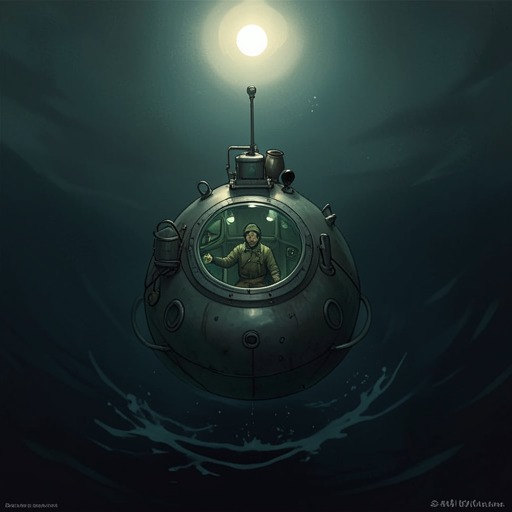
The disaster begins with the bomb-laden Kiowa falling into the deep-water vortex. Two thousand feet down, the aircraft is being dragged toward the ocean floor; its pilot, Delta-One, is already dead, while the Hellfire missiles remain attached. Their presence makes the sinking helicopter more than wreckage: it carries the means of setting off the eruption below.
As Rachel struggles in the darkness after escaping the Triton, the missiles’ warheads are forced inward by increasing pressure. The descending megaplume catches the wreckage and drives it against the red-hot crust of the magma dome. The fifteen high-explosive, antitank missiles then detonate in succession, blasting a hole through the dome. The chain of causes is sharply material: a failed escape route leaves the missiles with the aircraft; the vortex carries that armed wreck to the seafloor; the explosions breach the crust.
Eruption and Vortex Formation
Once the magma dome breaks apart, the underwater volcano erupts, sending magma at twelve hundred degrees Celsius into the sea. The heat vaporizes the water it meets, propelling a massive column of steam upward along the center of the megaplume. The event is not presented as a single blast that ends when the missiles explode; it becomes a self-intensifying circulation.
As steam rises, the surrounding currents twist downward in an anticyclonic spiral. The escaping vapor creates a vacuum that pulls millions of gallons of seawater toward the magma. At the bottom, that water flashes into steam and joins the ascending column, while more water rushes down to take its place. Each cycle strengthens the vortex: the hydrothermal plume lengthens, the whirlpool grows, and its upper rim advances toward the surface. The transformation of upward and downward motion into one tightening system gives the eruption its escalating force.
When the megaplume finally reaches the surface, the consequence is visible on a scale no longer confined to the deep. A huge, basin-shaped depression forms in the sea and expands rapidly; the ocean flows smoothly over its rim as a guttural moan rises from below. A towering geyser of steam then bursts upward, shattering the Goya’s bridge windows. The funnel steepens and spreads, turning the surrounding sea into an expanding abyss.
Rachel and Tolland in the Water
The eruption’s immediate human stakes are established before the vortex reaches the surface. Rachel has escaped the Triton but, submerged in black water, cannot tell which way leads upward. The sudden flash from the exploding missiles gives Michael Tolland a momentary view of her hanging below him and of the submarine falling away. He dives toward her just as the volcano erupts beneath them.
Rachel swims toward a distant red glow, mistaking the uncertain light for a possible route to the surface. Tolland catches her ankle and turns her around; she recognizes his hand and follows his pull. Their escape is an act of navigation in a space where darkness has erased any reliable sense of direction. When they break the surface, however, survival is not secured: the vortex is beginning to draw everything downward, and the wind and noise above the water have become stormlike.
The current tears Rachel from Tolland’s grasp, but upward rather than under. A Coast Guard Osprey, dispatched after a report of an explosion at sea and directed to the last known coordinates of a missing helicopter, winches Rachel aboard. Tolland remains in the water, exhausted and fighting the pull. The harness falls back within reach; he manages to get an arm and head through its loop, and the aircraft carries him upward as the vortex opens below. Their rescue depends not on escaping the sea unaided but on an outside response arriving at the scene of the explosion.
The Goya’s Destruction
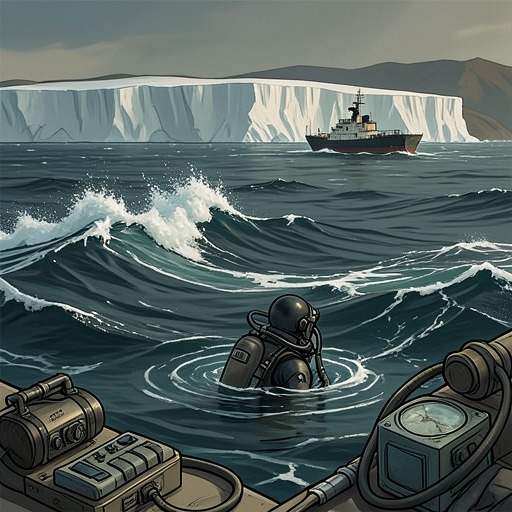
The eruption’s other principal witness is William Pickering, standing on the Goya’s bridge as the whirlpool forms beside the ship’s stern. He watches the widening depression and the sea racing over its lip, first unable to comprehend what he is seeing and then thrown to his knees by the blast of steam. The scale of the phenomenon makes the ship appear helpless: the funnel expands toward it, the stern swings toward the cavity, and the vessel is pulled toward the brink.
The steam’s concussion throws the Osprey sideways while Rachel and Tolland cling to each other. Looking down from the aircraft, they see Pickering kneeling at the Goya’s upper railing in his black coat and tie. As the stern fishtails over the edge, the anchor cable snaps. The ship, bow raised, slides backward down the spiraling wall of water; its lights remain visible as it disappears beneath the sea. Pickering’s last thoughts turn to his daughter, Diana, whom he hopes did not experience the fear he is facing.
Consequences and Significance
The catastrophe resolves the immediate danger to Rachel and Tolland through rescue, but it destroys the Goya and kills Pickering in the unfolding disaster. Its climax binds the plot’s human violence to the physical setting: the Hellfire missiles carried by the sinking helicopter ignite a process no one can control, and the resulting force consumes the vessel associated with the conspiracy.
The scene also changes the scale of the threat with each stage of its development. A damaged helicopter becomes an explosive trigger; a breach in the seafloor becomes an eruption; the eruption becomes a circulating column that reaches the surface and takes a ship. The rising steam and descending water make the vortex seem less like a sudden obstacle than a system that feeds itself. Against that expanding force, Rachel and Tolland’s escape is narrow and contingent, while Pickering and the Goya remain within its reach.